Wednesday, August 21, 2019
Session 24, August 21 with Recording
Contesting is a big part of Amateur Radio.
Some operators love contesting. Others shy away.
Whether you are into competing and building up a score is up to you.
The important part to understand is that for a new CW operator, contests are an opportunity to make contacts, whether you wish to enter your logs to be scored as part of the contest or not.
Contests are also a fantastic opportunity to test yourself. Some of the best CW operators in the world will work contests, especially the big DX contests in the fall and winter months.
Nobody in this class is among the best in the world yet, and that includes me, but that doesn't mean any one of us cannot make contact with the best. The best contesters want as many contacts at they can get, and that means they want to talk to you.
The trick is learning how to make contact with very fast stations, even though you would not normally be able to keep up with them.
The secret to working a contester that is faster than you is to take advantage of the many repeats a contester makes while working many stations one after another. It gives you the opportunity to gradually piece together their callsign and their contesting exchange a character or two at a time with each consecutive contact they make. Only after you already know most of what the other station is going to send do you make your first transmission and attempt to contact them.
It is this tactic that we attempted to simulate tonight. I intentionally ramped up the speed beyond your current abilities to give you the opportunity to try to piece together the callsign I was operating under and the rest of my information.
Don't get frustrated. This is an opportunity to learn. Fighting through contacts like these are a very valuable training technique that will help you dramatically increase your speed. At first you won't copy much, but as you listen to multiple CQs you'll learn how to copy a character or two each pass. Gradually you'll figure out the callsign of the faster station. The first few times you attempt this, it may seem impossible. DON'T GIVE UP. Listening to multiple contacts being made at a fast speed is a valuable opportunity. Don't ignore the opportunity. Take advantage of it.
Session 24, August 21 Recording
Mark,
NRØR

Monday, August 19, 2019
After Session 23 HF listening. with Recording.
After class on Monday, Aug 19 we did a few minutes of HF listening.
Here is a recording of the signals on 40m.
Somewhere around 7.056MHz if I recall correctly. I forgot to log the exact frequency.
After you have listened and copied the signals from this recording, scroll down to get the text that I copied of the above signals.
WT
BACK ON FEB. THIS YEAR BT CHECK OUT THE SKCC CLUB. SKCC CLUB. ACT IVE CW GROUP BT IJOINED THIS CP BT THE Y9WEB. THE Y KEEP C.W. ALIVE ORICK BK WB4HNL DE KE5JP KN
RR DE WB4HNL BT GOT MOST OF THAT FRANK BUT IM RUSTY AND ITS GETTING LATE FOR ME BT BT UR SIG HAEE GOT EN STRONGER ES NOW S9 PLUS BT ID BETTER SAY GN FRANK B ENJOYED THE QSO ES WILL CHECK THE SKCK BT 73 73 AR KE5JP DE WB4HNL SK
RR DE KE5JP UR FIST IS FB FB FE CHELK OUT SKCC CLUB. SKCC BT CLUB. ON THE WEB TNX FER QSO ES 73 73 GOD BLESS WB4HNL DE KE5JP K
Keep practicing.
Keep improving.
Don't get discouraged.
You each have come a very very long way in 6 weeks.
You are on the verge of getting on the air, and it won't be long before you are able to copy faster code with most stations on the air. IF YOU KEEP PRACTICING.
Mark,
NRØR
Session 23, August 19
Great Class.
I love it when STUDENTS bring questions and issues to class.
Keep jotting down questions as you practice. Keep making notes of any issues you are having. Bring them up during the next class, and we will address them.
Links discussed during this class:
Straight Key Century Club:
https://skccgroup.com/
SKCC Schedule page:
https://sked.skccgroup.com/
WA7BNM's Contest Calendar website.
Great place to look up what contests are going on.
https://www.contestcalendar.com/
Kansas QSO Party website:
http://www.ksqsoparty.org/
I will try to make some time available this weekend during the KS QSO party. The intent is to be available on the 145.17 Raytown repeater to work with anyone that may be trying to make a few contacts during this weekend's contest. No promises that I will actually have the time, but I will try. I should know more about if/when I will be available by Friday's class.
Whether I am available on the repeater or not, I suggest anyone that is trying to make contacts during the contest to mention their efforts on the repeater to see if anyone else is trying as well. It can be great fun to work together trying to chase down contacts and comparing notes. If you do work together, and if you submit your log to be scored as part of the contest, just be certain you do not submit your entry in the "unassisted" category.
160m, 80m, and 40m will be your best bets on HF to make contacts during that contest, if you have antennas up for any of those bands.
One good way for a new CW operator to make contacts is to make them during a contest. The format of Contesting QSOs is very structured and predictable, which can make it easier. Contacts tend to be very short and simple.
For a new CW operator trying to make contacts during a contest, it's best to begin by seeking out stations calling CQ instead of calling CQ yourself. As your CQ skills grow and develop, you will find that you can usually make more QSOs and make them faster by calling CQ, but it takes time to hone your skills such that you are able to call CQ and make QSOs smoothly. Give yourself the time to learn how contesting works before trying to call CQ. The best education is to make plenty of Search and Pounce contacts (S&P is when you are answering other stations calling CQ.)
Remember, not every contest during the year will be like KSQP. Different contests will exchange different information. Look them up in the Contest Calendar to verify what information is being exchanged. Listen to stations make contacts to learn how they are exchanging that information. Follow the patterns.
Don't expect every contact to be successful.
Some stations won't hear you. Try to contact them several times, and if you can't get through, tune around and try some other stations, and come back to the station that couldn't hear you later, perhaps propagation will improve, or perhaps the pileup of other stations will be smaller.
Some QSOs will fall apart half way through. Sometimes propagation shifts such that one station or the other will no longer be able to hear the other. Sometimes QRM will make a station uncopyable. Sometimes QSB will get worse. If a QSO falls apart, just move on and try to work someone else. Maybe you'll get a chance to work that station again later.
You may be surprised at how many stations you will be able to work, including stations transmitting very fast morse code. If you are patient and listen to them make enough QSOs before trying to work them, your current code skill is probably more than sufficient to copy stations at 25 wpm, as long as you hear them repeat the information several times. Even if you cannot copy a long rag chew QSO at 10wpm, you may be able to make contest QSOs at 25wpm because the information is repeated so much. There will likely be very few stations in the KSQP that you will not be able to work if you are patient enough to listen to them make several contacts and piece together all of their information before you initiate a transmission to them.
That said, you should try to work slower stations first, and then muster your courage to start working on the faster ones. Don't be afraid to listen to someone make 10 or 15 contacts as you try to figure out their callsign and location before trying to contact them.
It is not a requirement, but if you want to, please feel free to record some of your contacts and email me an mp3 file. I will be happy to publish some actual QSOs on learnmorsekc.blogspot.com
HAVE FUN!!!
Sorry, no recording was made of Session 23.
Mark
NRØR
I love it when STUDENTS bring questions and issues to class.
Keep jotting down questions as you practice. Keep making notes of any issues you are having. Bring them up during the next class, and we will address them.
Links discussed during this class:
Straight Key Century Club:
https://skccgroup.com/
SKCC Schedule page:
https://sked.skccgroup.com/
WA7BNM's Contest Calendar website.
Great place to look up what contests are going on.
https://www.contestcalendar.com/
Kansas QSO Party website:
http://www.ksqsoparty.org/
I will try to make some time available this weekend during the KS QSO party. The intent is to be available on the 145.17 Raytown repeater to work with anyone that may be trying to make a few contacts during this weekend's contest. No promises that I will actually have the time, but I will try. I should know more about if/when I will be available by Friday's class.
Whether I am available on the repeater or not, I suggest anyone that is trying to make contacts during the contest to mention their efforts on the repeater to see if anyone else is trying as well. It can be great fun to work together trying to chase down contacts and comparing notes. If you do work together, and if you submit your log to be scored as part of the contest, just be certain you do not submit your entry in the "unassisted" category.
160m, 80m, and 40m will be your best bets on HF to make contacts during that contest, if you have antennas up for any of those bands.
One good way for a new CW operator to make contacts is to make them during a contest. The format of Contesting QSOs is very structured and predictable, which can make it easier. Contacts tend to be very short and simple.
For a new CW operator trying to make contacts during a contest, it's best to begin by seeking out stations calling CQ instead of calling CQ yourself. As your CQ skills grow and develop, you will find that you can usually make more QSOs and make them faster by calling CQ, but it takes time to hone your skills such that you are able to call CQ and make QSOs smoothly. Give yourself the time to learn how contesting works before trying to call CQ. The best education is to make plenty of Search and Pounce contacts (S&P is when you are answering other stations calling CQ.)
- Tune around and find a station calling CQ Test, or in the case of this weekend's Kansas QSO party (aka KSQP), many stations will be calling CQ KS, or perhaps CQ KSQP.
- LISTEN.
- Listen to a CQing station make a contact or two. Copy both sides of the conversation. Learn the callsign of the CQing station, as well as their exchange, for the KSQP they will be exchanging Callsigns, RST, and Location. Without a single transmission, you should be able to copy a station's Callsign and their Location by listening to them make contacts with other stations. That will reduce the amount of information you will need to copy under the pressure of a live conversation.
- Attempt to make contact.
- Listen for the CQing station to send a CQ, or for them to transmit QRZ
- Transmit your callsign only, then listen CAREFULLY.
- Listen for the CQing station to send your callsign CORRECTLY. They may also send your RST report and QTH at this time. Pay particular attention to the RST numbers because that is the one piece of information you won't be able to copy in advance of trying to make contact.
- If the station transmits someone else's callsign, be patient. Wait for that contact to be completed, and try again the next time they call CQ or QRZ.
- If the station transmits part of your callsign, but misses part of it, or gets part of your callsign incorrect, transmit your callsign only again, and listen again. Repeat this process as many times as is necessary for the other station to transmit your callsign back to you ACCURATELY, or until the other station responds to someone else. Remember, it is the persistent operator that will succeed.
- Once the station repeats your callsign CORRECTLY, only then should you transmit your exchange information. Remember, the moment you transmit your exchange information, you are effectively telling the other station that they have copied your callsign correctly, and they will very likely no longer be paying attention to what you send for your callsign!
- For KSQP, give them an RST report and your location (either the county in KS you are located, or the state you are located if you are not in KS) You do not need to include callsigns at this point, just stick to the exchange only.
- For example, "599 MO 599 MO KN"
or perhaps "5NN JOHNSON 5NN JOHNSON KN" - After transmitting your exchange information listen carefully again. The other station may ask you for a repeat. During a contest that could be as simple as the other station transmitting, "AGN?" or sometimes a simple "?" or sometimes they may be more specific and send "RST?", "SIGS?" or "QTH?" or "ST?" or "Cty?" where they are asking for you to repeat RST, QTH, the State, or County you live in. "SIGS?" is rarely used, but it is a request for another Signal Report, which you should respond with a repeat of the RST.
- Only repeat the exchange information if they ask for it. If you do repeat it, go ahead and send it at least twice.
- Remember that the other station may NOT ask for a repeat, and may simply skip forward and send you his/her exchange information for you to copy.
- At this point, you should have copied the other stations location before you ever started transmitting, so your primary focus will be to copy the RST report the other station is giving your signal. It will usually be 599 or 5NN. However, DO NOT ASSUME. Copy what they send to be certain.
- If you need them to repeat it, just send "AGN?"
- Once you have copied their exchange, transmit, "TU"
- The other station may respond with a TU or with a {shave and a haircut} or just with {two bits}
- You can respond with your own {two bits}
- Congratulations, you just made a CW contest QSO.
- Tune around and find another station calling CQ TEST, CQ KS, or CQ KSQP and try again.
Remember, not every contest during the year will be like KSQP. Different contests will exchange different information. Look them up in the Contest Calendar to verify what information is being exchanged. Listen to stations make contacts to learn how they are exchanging that information. Follow the patterns.
Don't expect every contact to be successful.
Some stations won't hear you. Try to contact them several times, and if you can't get through, tune around and try some other stations, and come back to the station that couldn't hear you later, perhaps propagation will improve, or perhaps the pileup of other stations will be smaller.
Some QSOs will fall apart half way through. Sometimes propagation shifts such that one station or the other will no longer be able to hear the other. Sometimes QRM will make a station uncopyable. Sometimes QSB will get worse. If a QSO falls apart, just move on and try to work someone else. Maybe you'll get a chance to work that station again later.
You may be surprised at how many stations you will be able to work, including stations transmitting very fast morse code. If you are patient and listen to them make enough QSOs before trying to work them, your current code skill is probably more than sufficient to copy stations at 25 wpm, as long as you hear them repeat the information several times. Even if you cannot copy a long rag chew QSO at 10wpm, you may be able to make contest QSOs at 25wpm because the information is repeated so much. There will likely be very few stations in the KSQP that you will not be able to work if you are patient enough to listen to them make several contacts and piece together all of their information before you initiate a transmission to them.
That said, you should try to work slower stations first, and then muster your courage to start working on the faster ones. Don't be afraid to listen to someone make 10 or 15 contacts as you try to figure out their callsign and location before trying to contact them.
It is not a requirement, but if you want to, please feel free to record some of your contacts and email me an mp3 file. I will be happy to publish some actual QSOs on learnmorsekc.blogspot.com
HAVE FUN!!!
Sorry, no recording was made of Session 23.
Mark
NRØR
Friday, August 16, 2019
Session 22, August 16 with Recording
Friday Fun Night
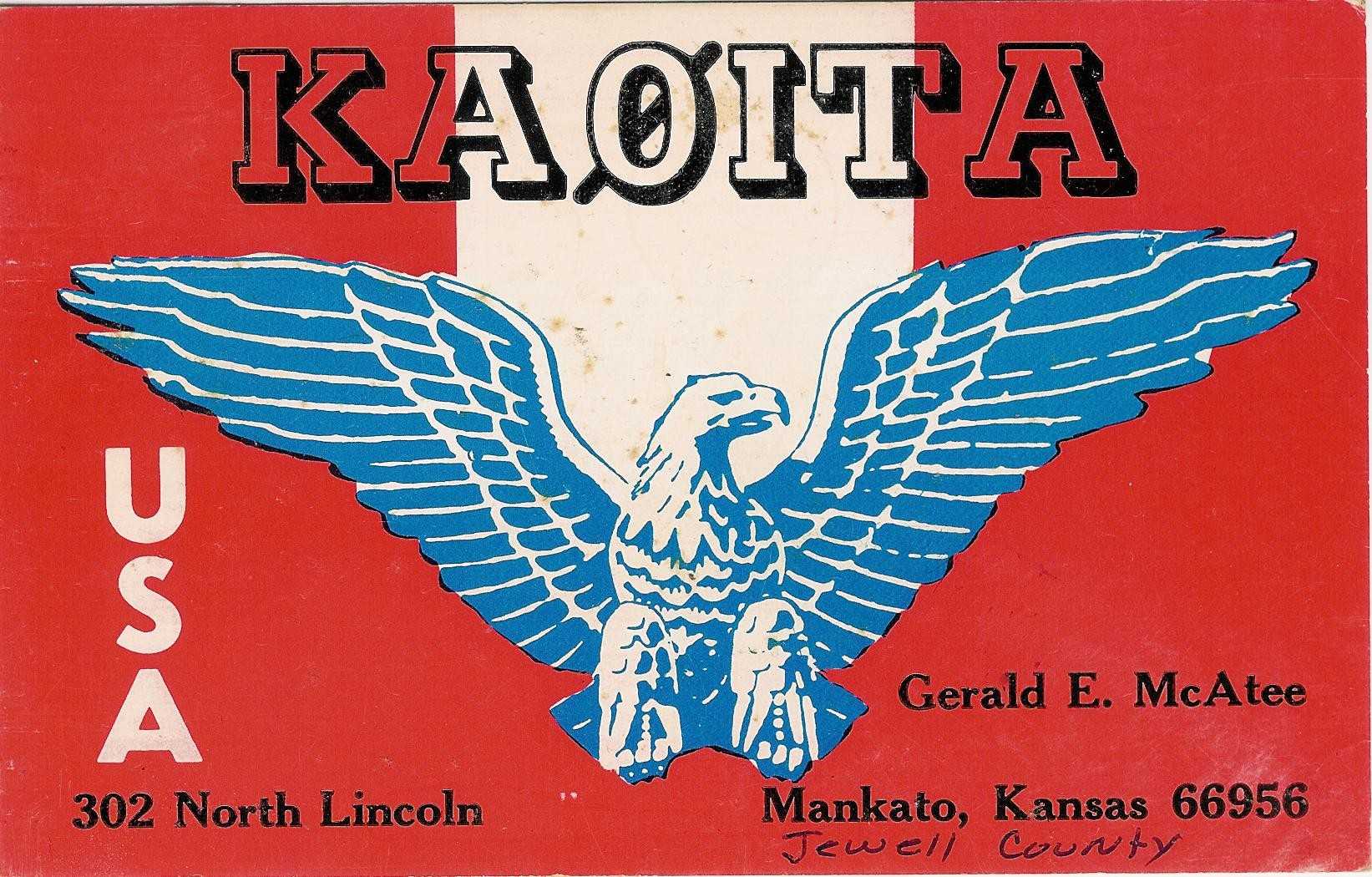
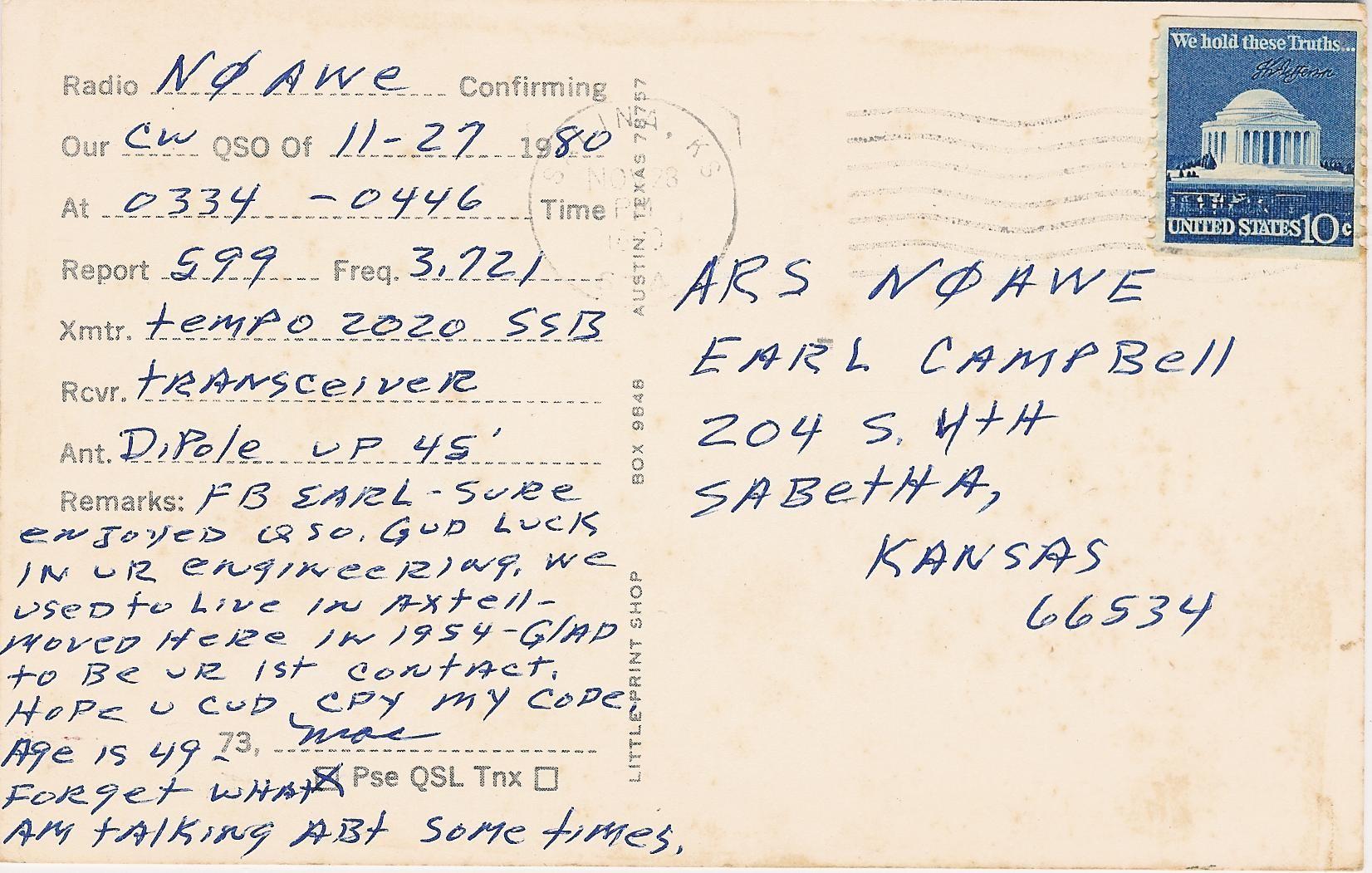
Tonight's Special Guest was my brother!
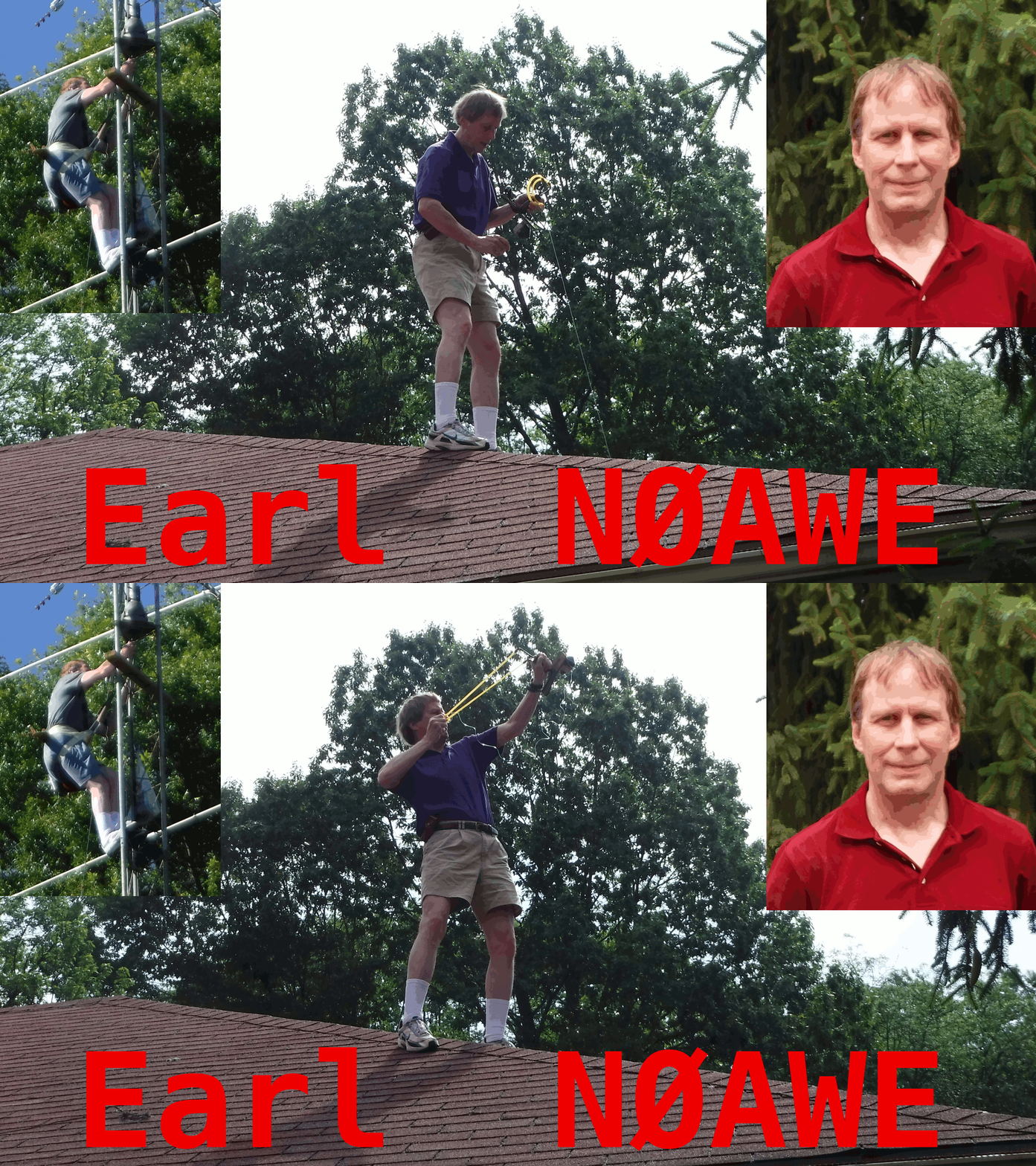
Earl shared the story of his first ham radio contact.
Thanks big brother.
Tonight was also Friday Fun Night.
Back by popular request, Morse Code Bingo.
If you are listening to the recording and wish to play along,
Choose 2 bingo cards from:
Click Here: KC Landmarks & BBQ Bingo Cards
Session 22, August 16 Recording
See everyone Monday,
Mark,
NRØR
Tonight's Special Guest was my brother!
Earl shared the story of his first ham radio contact.
Thanks big brother.
Tonight was also Friday Fun Night.
Back by popular request, Morse Code Bingo.
If you are listening to the recording and wish to play along,
Choose 2 bingo cards from:
Click Here: KC Landmarks & BBQ Bingo Cards
Session 22, August 16 Recording
See everyone Monday,
Mark,
NRØR
Bingo Cards for Session 22
Greetings,
Use the link below to get your LearnMorseKC Bingo Cards.
This week, please pick 2 cards to play, but choose a 3rd card as an alternate. Have all three printed off ready to play at 7pm. If two players choose the same card(s) I will offer them the opportunity to swap in an alternate card if they choose to.
During waterfall check-in please give your callsign, plus the two card numbers you have chosen to play.
As before it would be a good idea to have 35 or so small objects to use as game pieces to cover bingo squares. Use whatever you have laying around. Maybe you have spare 7805 voltage regulators, or 7474 flip flop chips, or RJ45 microphone connectors (everyone has 35 broken ones right?), or pop caps (remember metal pop caps?), or unground coffee beans, or dry pinto beans, or dry lentils, or peppermint candies, or unpopped popcorn kernels, or popped popcorn kernels if you have the willpower to avoid eating your game pieces before the game is over. Feel free to substitute other objects of your choosing that you have laying around for game pieces.
Click Here: LearnMorseKC Bingo Cards
KC Landmarks and BBQ series
Let's have fun tonight.
7pm 145.17 Raytown Repeater
Mark
NRØR
Use the link below to get your LearnMorseKC Bingo Cards.
This week, please pick 2 cards to play, but choose a 3rd card as an alternate. Have all three printed off ready to play at 7pm. If two players choose the same card(s) I will offer them the opportunity to swap in an alternate card if they choose to.
During waterfall check-in please give your callsign, plus the two card numbers you have chosen to play.
As before it would be a good idea to have 35 or so small objects to use as game pieces to cover bingo squares. Use whatever you have laying around. Maybe you have spare 7805 voltage regulators, or 7474 flip flop chips, or RJ45 microphone connectors (everyone has 35 broken ones right?), or pop caps (remember metal pop caps?), or unground coffee beans, or dry pinto beans, or dry lentils, or peppermint candies, or unpopped popcorn kernels, or popped popcorn kernels if you have the willpower to avoid eating your game pieces before the game is over. Feel free to substitute other objects of your choosing that you have laying around for game pieces.
Click Here: LearnMorseKC Bingo Cards
KC Landmarks and BBQ series
Let's have fun tonight.
7pm 145.17 Raytown Repeater
Mark
NRØR
Thursday, August 15, 2019
Session 21, August 14 with Recording
As reported during class, everyone should now know more than enough information to get on the air and start making contacts. The primary thing each of you needs to now do is build up your accuracy and speed to where you feel comfortable and confident enough to take the courageous step and get on the air and make that first contact.
If you feel up to it and want to venture out on your own, go for it.
If you would rather have an Elmer working with you for the first contact, that is fine too. I'm willing to help if that is your wish. The choice is yours.
While listening to live ham conversations over the air using your own radio continues to be the BEST way to practice because it allows you to copy the real thing. It also helps you gauge your abilities and have a better idea when you are ready to start making contacts.
We discussed W1AW tonight.
Their over the air W1AW schedule is a good second choice to practice your code at ever increasing code speeds. The fact that it happens over the air is a good thing. Over the air practice is far superior to recordings.
http://www.arrl.org/w1aw-operating-schedule
Remember, you can use a websdr to listen to live over the air from any device with internet access if you find yourself away from your own hf radio.
http://www.sdrutah.org/websdr1.html
Recommend you select '40cw' and 'CW-med'
http://www.sdrutah.org/websdr2.html
During daylight hours, I recommend you select '20cw' and 'CW-med'. Sadly, during nighttime hours, this receiver will be mostly dead. Such is the nature of our current position in the 11 year sunspot cycle.
More websdr sites can be found at:
http://websdr.org/
Sometimes that page is slow to load. Be patient. Sometimes you'll need to refresh your browser a time or two to get it to come up. Once you find a particular websdr receiver site you like, I recommend you bookmark that particular site and go directly there rather than going through websdr.org every time.
If you wish to resort to recordings, that's okay too. It's not as good as copying live conversations over the air, but it's better than skipping practice time. It does have the advantage that recordings can be downloaded so that they will be available even if the internet is unavailable.
ARRL has plenty of good CW practice files available for download.
http://www.arrl.org/code-practice-files
There are a multitude of other great morse code resources out there. If you want me to check something out and offer an opinion on one, send me a link and I'll be happy to.
None of the above should mislead you into thinking that I'm casting you to the static to sink or swim all by yourself. Our classes will continue, but you should now consider our VHF get togethers as one part of a spectrum of resources at your disposal to help you gain speed, accuracy, and confidence to get on the air. You have a full buffet of practicing options at your fingertips. Exploit them. Every chance you get.
As you are practicing, you may come up with questions. Jot them down and bring them to the next class. Feel free to see if you can befuddle the instructor.
Session 21, August 14 Recording
See you for Friday Fun Night.
We may have a special Mystery Guest!
Morse Code Bingo may make its triumphant return due to popular demand.
Mark,
NRØR
If you feel up to it and want to venture out on your own, go for it.
If you would rather have an Elmer working with you for the first contact, that is fine too. I'm willing to help if that is your wish. The choice is yours.
While listening to live ham conversations over the air using your own radio continues to be the BEST way to practice because it allows you to copy the real thing. It also helps you gauge your abilities and have a better idea when you are ready to start making contacts.
We discussed W1AW tonight.
Their over the air W1AW schedule is a good second choice to practice your code at ever increasing code speeds. The fact that it happens over the air is a good thing. Over the air practice is far superior to recordings.
http://www.arrl.org/w1aw-operating-schedule
Remember, you can use a websdr to listen to live over the air from any device with internet access if you find yourself away from your own hf radio.
http://www.sdrutah.org/websdr1.html
Recommend you select '40cw' and 'CW-med'
http://www.sdrutah.org/websdr2.html
During daylight hours, I recommend you select '20cw' and 'CW-med'. Sadly, during nighttime hours, this receiver will be mostly dead. Such is the nature of our current position in the 11 year sunspot cycle.
More websdr sites can be found at:
http://websdr.org/
Sometimes that page is slow to load. Be patient. Sometimes you'll need to refresh your browser a time or two to get it to come up. Once you find a particular websdr receiver site you like, I recommend you bookmark that particular site and go directly there rather than going through websdr.org every time.
If you wish to resort to recordings, that's okay too. It's not as good as copying live conversations over the air, but it's better than skipping practice time. It does have the advantage that recordings can be downloaded so that they will be available even if the internet is unavailable.
ARRL has plenty of good CW practice files available for download.
http://www.arrl.org/code-practice-files
There are a multitude of other great morse code resources out there. If you want me to check something out and offer an opinion on one, send me a link and I'll be happy to.
None of the above should mislead you into thinking that I'm casting you to the static to sink or swim all by yourself. Our classes will continue, but you should now consider our VHF get togethers as one part of a spectrum of resources at your disposal to help you gain speed, accuracy, and confidence to get on the air. You have a full buffet of practicing options at your fingertips. Exploit them. Every chance you get.
As you are practicing, you may come up with questions. Jot them down and bring them to the next class. Feel free to see if you can befuddle the instructor.
Session 21, August 14 Recording
See you for Friday Fun Night.
We may have a special Mystery Guest!
Morse Code Bingo may make its triumphant return due to popular demand.
Mark,
NRØR
Monday, August 12, 2019
Session 2Ø, August 12 with Recording
Congratulations to David, KØDZX on his first HF CW QSO!
The first of many more to come, I'm sure.
It was great to hear his description of the event.
On a side note, check out David's impressive eclipse photo on his QRZ page.
David mentions the Straight Key Century Club: https://www.skccgroup.com/
and the SKCC Sked page: https://sked.skccgroup.com/
The best way to improve your morse code skills is to USE them. Listening on HF radio is great practice to prepare for making contacts, but getting on the air and actually making them is even better still. That is why the goal of this course is to get each of you on the air making contacts. There is no better way to train and improve your skills.
Use your courage to test your limits. The best CW operators constantly push themselves to improve. Not just in speed, but in accuracy. The ability to copy information correctly the first time is incredibly valuable.
Skilled CW operators will test their limits on a regular basis, and intentionally put themselves on the edge of being able to copy. That is where improvement comes from. The more repetitions you get at a speed that you can just barely cope with, the more comfortable and accurate you will become. Before long you will be going even faster and doing it all over again. Put yourself in that mindset where pushing your limits is part of the fun, because it is!
Session 2Ø, August 12 Recording
Mark,
NRØR
The first of many more to come, I'm sure.
It was great to hear his description of the event.
On a side note, check out David's impressive eclipse photo on his QRZ page.
David mentions the Straight Key Century Club: https://www.skccgroup.com/
and the SKCC Sked page: https://sked.skccgroup.com/
The best way to improve your morse code skills is to USE them. Listening on HF radio is great practice to prepare for making contacts, but getting on the air and actually making them is even better still. That is why the goal of this course is to get each of you on the air making contacts. There is no better way to train and improve your skills.
Use your courage to test your limits. The best CW operators constantly push themselves to improve. Not just in speed, but in accuracy. The ability to copy information correctly the first time is incredibly valuable.
Skilled CW operators will test their limits on a regular basis, and intentionally put themselves on the edge of being able to copy. That is where improvement comes from. The more repetitions you get at a speed that you can just barely cope with, the more comfortable and accurate you will become. Before long you will be going even faster and doing it all over again. Put yourself in that mindset where pushing your limits is part of the fun, because it is!
Session 2Ø, August 12 Recording
Mark,
NRØR
Subscribe to:
Posts (Atom)